
GST guide
Delivery Challan Under GST: When You Need One, Its Fields and Copies
Rule 55 of the CGST Rules decides when goods can move on a challan instead of a tax invoice, what the challan must show and, for a supply, its three copies. Each part in plain words, with the e-way bill link and what a challan book needs.
Published • 14 min read • GST · Delivery challans
What is a delivery challan?
A delivery challan is the document a consignor issues instead of a tax invoice when goods are removed for transport in the cases Rule 55 of the CGST Rules allows: job work, transport for reasons other than by way of supply, liquid gas whose quantity is not known when it leaves, and other supplies the Board notifies. It must carry nine particulars, and when it covers a supply it is prepared in triplicate.
- Set by
- Rule 55
- Particulars
- 9
- Copies, for a supply
- 3
- Challan number
- ≤ 16 chars
A delivery challan is not a traffic e-challan, the fine notice for a vehicle offence. It is the paper that moves goods when no tax invoice is issued at removal: goods going to a job worker, stock moving between two godowns under one GSTIN, goods sent on approval. Here is when you can use one, what it must say, how many copies to make, how it links to the e-way bill, and what a challan book needs.
Need the challan itself?
Our free delivery challan comes in 11 versions, from a standard A4 challan to duplicate and triplicate challan books. Type on it, download, print. No sign-up.
01 · Rule 55(1)
When is a delivery challan issued instead of a tax invoice?
Rule 55(1) of the CGST Rules lists the cases in which the consignor may issue a delivery challan “in lieu of invoice at the time of removal of goods for transportation”:
- supply of liquid gas where the quantity at the time of removal from the supplier’s place of business is not known
- transportation of goods for job work
- transportation of goods for reasons other than by way of supply
- such other supplies as the Board notifies
An ordinary sale moves on a tax invoice. How the main cases work:
Job work
Rule 45 says inputs and capital goods go to the job worker “under the cover of a challan issued by the principal”, and that challan carries the Rule 55 details. When goods come back, or go on to another job worker, the job worker may endorse the principal’s challan with the quantity and description. Challan details are also reported in FORM GST ITC-04.
Within one GSTIN
Moving stock between two godowns under the same registration is not a supply, so it goes on a challan. A transfer to your own branch with a different GSTIN is a supply: each registration is a distinct person under section 25(4) of the CGST Act, and Schedule I treats supplies between distinct persons in the course of business as supplies even without consideration. That transfer needs a tax invoice.
Goods on approval
CBIC Circular No. 10/10/2017 of 18 October 2017 says goods taken for supply on approval can move on a delivery challan, with an e-way bill wherever applicable, and the invoice can be issued at delivery. Section 31(7) of the CGST Act sets the deadline: at the time of supply or six months from removal, whichever is earlier.
Invoice after delivery
Where goods are moving for supply to the recipient but the tax invoice could not be issued at removal, Rule 55(4) says the supplier issues the tax invoice after delivery of the goods.
Machinery in parts, or a load in batches
For goods sent in a semi knocked down (SKD) or completely knocked down (CKD) condition, or in batches or lots, Rule 55(5) sets the order:
- Invoice first. The supplier issues the complete invoice before the first consignment leaves.
- A challan for each later load. Each subsequent consignment gets its own delivery challan, giving the reference of the invoice.
- Papers with every load. Each consignment carries copies of its challan and a duly certified copy of the invoice.
- Original with the last. The original invoice goes with the last consignment.
Job work: the one-year and three-year limits
Inputs sent to a job worker that are neither brought back nor supplied from the job worker’s premises within one year, and capital goods within three years, are treated as supplied by the principal to the job worker on the day they were sent out (section 143 of the CGST Act). Moulds and dies, jigs and fixtures, or tools are outside the capital-goods limit. The Commissioner can extend the periods by up to one year and two years. Rule 45(4) then has the principal declare that supply in GSTR-1 and pay the tax with interest.
02 · Rule 55 particulars
What must a delivery challan contain?
Rule 55(1) says the challan is “serially numbered not exceeding sixteen characters, in one or multiple series”, and lists nine particulars:
- date and number of the delivery challan
- name, address and GSTIN of the consignor, if registered
- name, address and GSTIN or Unique Identity Number of the consignee, if registered
- HSN code and description of goods
- quantity (provisional, where the exact quantity being supplied is not known)
- taxable value
- tax rate and tax amount (central tax, State tax, integrated tax, Union territory tax or cess), where the transportation is for supply to the consignee
- place of supply, in case of inter-State movement
- signature
What Rule 55 does not ask for
Some things often said about challans come from other rules. Rule 55 says nothing about:
- consecutive numbering, or a number unique for a financial year: those words are in Rule 46, which covers tax invoices
- how many digits of HSN to show: that rule also belongs to tax invoices
- the time of issue, the unit of measure, a reason for transport or a return-by date
- the language the challan is written in
Some of these are still worth having. Part A of the e-way bill asks for the reasons for transportation (CBIC’s e-way bill flyer), and our standard challan has a reason box for it.
What our free challans have
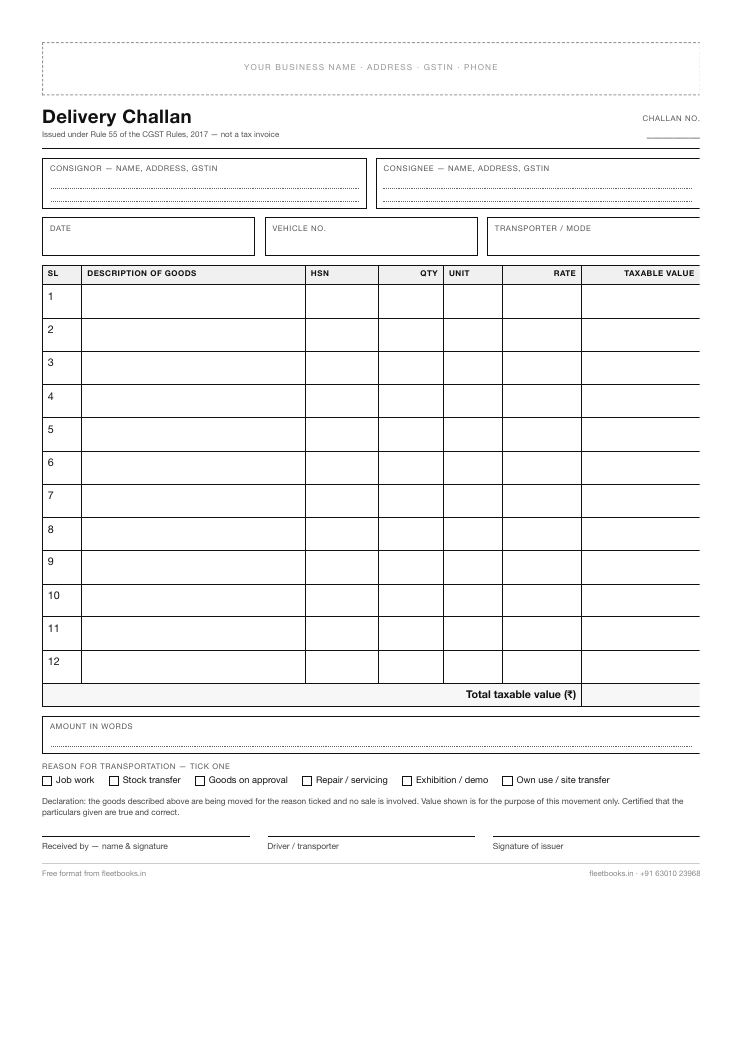
Every challan in our delivery challan format has a challan number, date, consignor and consignee boxes, a description of goods, quantity and unit, and signature lines. The rest differs:
HSN, rate and taxable value
The standard challan, the filled and job-work samples, the returnable and e-way bill challans, and the Excel, Word and Hindi versions.
Taxable value, no HSN
The duplicate and triplicate challan books.
No HSN, no value
The simple challan, a short form.
None has columns for tax rate and amount. The sheets you type on have no place-of-supply line, though the Excel file has a cell for it. So add what your movement needs: for an inter-State movement, write the place of supply in the consignee box; where the challan covers a supply to the consignee, add the tax rate and amount, for example in the Word file, which is an editable copy; on a challan book, write the HSN with the description.
03 · Rule 55(2)
How many copies of a delivery challan?
Three, when the challan covers a supply of goods. Rule 55(2) says the delivery challan “shall be prepared in triplicate, in case of supply of goods”, with each copy marked:
Original
ORIGINAL FOR CONSIGNEE
Duplicate
DUPLICATE FOR TRANSPORTER
Triplicate
TRIPLICATE FOR CONSIGNER
For job work, transfers within one GSTIN and other movements that are not a supply, Rule 55 states no number of copies. Three marked copies is still the safe habit. Nothing in the rule ties the number of copies to who owns the vehicle.
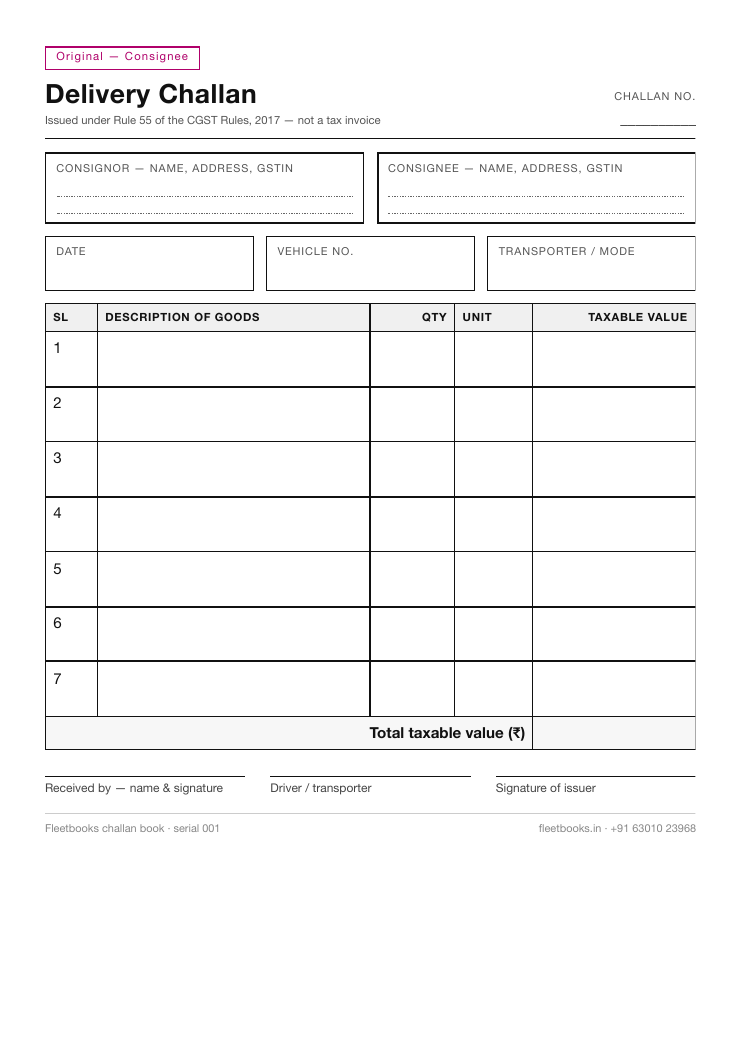
Our triplicate challan book is laid out for three copies per challan, and the duplicate book for two, so the duplicate book is not the three-copy set Rule 55(2) describes for a supply. The sheet you fill on the site prints without a copy marking unless you switch on the copy label, which stamps “Original — Consignee”. For a supply, make sure each copy carries its own marking, by hand or printed by the press.
04 · Rule 138
Do you need an e-way bill with a delivery challan?
Often, yes. Rule 55(3) says that where goods are transported on a delivery challan in lieu of invoice, they must be declared as specified in Rule 138, the e-way bill rule.
- Above ₹50,000. Rule 138(1) requires the e-way bill before the movement of goods of consignment value exceeding ₹50,000, whether the movement is in relation to a supply or for reasons other than supply. The value is the one declared on the invoice, bill of supply or delivery challan, plus any GST charged. Some states set a higher limit for movement within the state.
- Inter-State job work, at any value. Where a principal in one state sends goods to a job worker in another, the principal or the job worker, if registered, generates the e-way bill irrespective of the value.
- Who generates it. The consignor or the consignee when it moves the goods itself, or the transporter when the goods are handed over to one.
- Where the challan goes. Part A of the e-way bill carries the document number and date, and CBIC lists the delivery challan as one of those documents, with the tax invoice, bill of supply and bill of entry. Part B carries the transport details: the transport document number and the vehicle number.
- Validity. It counts from when the e-way bill is generated, not from the challan’s date: one day per 200 km, or per 20 km for over-dimensional cargo.
What the driver carries. Rule 138A requires the person in charge of the vehicle to carry the invoice, bill of supply or delivery challan, and a copy of the e-way bill or its number. Where no e-way bill is needed, Rule 55A names only the tax invoice or the bill of supply. It does not mention the challan, but carrying it is sensible practice: it describes the goods and why they are moving.
Weighbridge trips. No e-way bill is needed to take goods up to 20 km from the consignor’s place of business to a weighbridge and back, on condition that the goods are accompanied by a delivery challan issued under Rule 55 (Rule 138(14)(n)).
Our challan with e-way bill rows has boxes for the e-way bill number, its date and validity, so the two documents point at each other. Writing the e-way bill number on the challan is practice, not a rule.
05 · Challan books
What is a challan book?
A challan book is a bound pad of pre-numbered delivery challans, usually with carbon between the copies, so one pen stroke fills every copy and one copy stays in the book.
GST allows one. The only numbering rule is in Rule 55(1): serially numbered, not exceeding sixteen characters, in one or multiple series. No rule requires a challan to be printed or electronic, and none prohibits a pre-printed bound book. We found no GST-era requirement to register a pre-printed book with the department.
A pre-printed book meets Rule 55 when:
- each challan number is 16 characters or fewer
- each leaf carries all nine Rule 55 particulars
- for a supply, the three copies carry the Rule 55(2) markings
Keep spoiled leaves. Write CANCELLED on every copy and leave them in the book. Delivery challans are reported by number range in GSTR-1 Table 13, and Rule 56 lists them among the records a registered person must keep.
Rule 55 lets challans be numbered in one or more series of their own. Keeping that series separate from your invoices is good practice, not a rule.
Our challan books
Our challan book format and the triplicate book print an A5 leaf. It has the challan number, date, consignor, consignee, vehicle number, transporter, description, quantity, unit, taxable value and three signature lines. It has no HSN column and no place-of-supply line, so write the HSN with the description and, for an inter-State movement, the place of supply, or ask the press to add both before it prints the book.
06 · Step by step
How do you prepare a delivery challan?
In this order, on our free delivery challan format or your own:
- Check that a challan fits. Job work, a movement that is not a supply, liquid gas, or one of the Rule 55(4) and 55(5) cases. A sale, or a transfer to a branch with its own GSTIN, needs a tax invoice.
- Take the next number. From your series, 16 characters or fewer, before you fill anything else.
- Date and both parties. The date; your name, address and GSTIN as consignor; the consignee’s name and address, with its GSTIN or UIN if registered.
- Describe the goods. Description and HSN code, then the quantity. If the exact quantity being supplied is not known yet, a provisional quantity is allowed.
- Value them. Enter the taxable value. It is also the value the e-way bill threshold is checked against.
- Tax and place of supply, where they apply. The tax rate and amount where the transportation is for supply to the consignee; the place of supply for an inter-State movement.
- Tick the reason. Rule 55 does not ask for it, but the e-way bill does. Our standard challan lists job work, stock transfer, goods on approval, repair / servicing, exhibition / demo and own use / site transfer.
- E-way bill. Above ₹50,000, or for inter-State job work at any value, generate the e-way bill, with the challan number and date in Part A, before the goods move.
- Sign and split the copies. Sign it. For a supply, make three copies marked for the consignee, the transporter and the consignor.
Each version on our delivery challan format page opens a sheet you type straight onto and download, with no sign-up. For goods going out to a job worker, the job-work sample shows one filled in.
07 · Three documents
Delivery challan, tax invoice or lorry receipt?
They are three different papers, and one load can carry more than one.
Tax invoice
Issued by the supplier for a supply of goods. An ordinary sale moves on it.
Delivery challan
Issued by the consignor in place of the invoice, in the Rule 55 cases: job work, movements that are not a supply, liquid gas, and the Rule 55(4) and 55(5) cases.
Lorry receipt (LR)
Issued by the transporter for the goods it takes for carriage. Its number goes into Part B of the e-way bill as the transport document number.
When a transporter carries goods that move on a challan, the vehicle carries the consignor’s challan and often the transporter’s LR as well.
For the transporter’s side, our guide explains what an LR copy is and who keeps which copy.
Free delivery challan
Fill the challan, then check it against Rule 55.
Standard A4, filled and job-work samples, returnable, e-way bill, Excel, Word, Hindi, and duplicate and triplicate challan books. Type on it, download, print. Free, no sign-up.
Printing a pad? Use the challan book format.