
Guide
LR Copy (Lorry Receipt): Meaning, Copies and E-way Bill
What the paper is, what LR stands for, who keeps which copy, how a bilty fits in, and how an LR differs from an e-way bill.
Published • 9 min read • Lorry receipts · Transport documents
What is the LR copy?
An LR copy is a copy of the lorry receipt (LR), the document a transporter issues when it takes goods from a consignor. It is also called a bilty or a consignment note.
- LR stands for
- Lorry receipt
- Copies, common carrier
- 3
- E-way bill above
- ₹50,000
- LR number goes in
- Part B
Ask for the LR at a loading point and you are handed a paper with a number at the top right. Here is what that paper is, who keeps which copy, how it differs from an e-way bill, and how to make one.
Need an LR copy now?
The free blank A4 lorry receipt: type on it and download PDF, Word or Excel. No sign-up.
01 · The document
What an LR copy is, and what else it is called.
A lorry receipt (LR) is the document a transporter issues when it takes goods from a consignor. It records what was handed over, in what condition, to which vehicle and driver, and where the goods are going. An “LR copy” is one of the copies of that document.
The same paper has other names. “Bilty” is the word in common use in the North and West, and “lorry receipt” or “LR” is the usual word in South India. GST notifications call it a “consignment note”. The Carriage by Road Act, 2007 calls it a “goods receipt”. In everyday use all four names point at the same paper.
The consignor has a document of its own, which is different: under the same Act, every consignor executes a “goods forwarding note”, which includes a declaration about the value of the consignment and any dangerous or hazardous goods.
02 · Full form
LR full form.
LR stands for lorry receipt. When someone asks you for the LR, the LR copy, the bilty or the consignment note, they want this document.
03 · The copies
Which LR copy goes to whom.
For a common carrier, the law is specific about one thing only. A common carrier is one that carries goods for all persons without discrimination.
What the law says
The Carriage by Road Act, 2007 requires a common carrier to issue the goods receipt in triplicate, with the original given to the consignor. It also makes the goods receipt prima facie evidence of the weight or measure, the other particulars of the goods and the number of packages stated on it.
What is trade practice
The Act does not say who gets the other two copies, so this varies. One trade guide describes copies for the consignor, the consignee and the transporter. Some LR books are printed with four copies.
Even the consignee copy is described two ways. One guide calls it a delivery acknowledgment. A Bombay High Court record describes it as the paper the consignee presents to take delivery.
Our triplicate LR book is laid out as consignor, consignee and driver copies. That is our layout, not a legal requirement. If a customer asks for a particular set of copies, give them what they ask for.
04 · Bilty
What is a bilty in logistics?
A bilty is the same document as the lorry receipt, under the name used in the North and West. Nothing about the fields changes. If you search for a bilty format, the sheet you want is the one in this guide.
The box on a bilty that traders look at first is the freight term. It says who settles the freight, and you tick one:
To Pay
The consignee pays the freight when the goods are delivered, not the consignor at booking.
Paid
The consignor has already settled the freight with the transporter.
To Be Billed
Neither pays at the door. The freight goes onto a monthly transport bill instead.
The second box is the risk basis: carrier’s risk or owner’s risk. Both are tick-boxes on the sheet, so the consignor sees them before the goods move.
05 · The LR number
What the LR number is used for.
The LR number is the number at the top right of the sheet. It does three jobs.
- E-way bill. It is the number you enter in Part B of the e-way bill, as the transport document number (see the next section).
- Finding a consignment. It is the reference you quote when you ask where a consignment is, or when you file a claim.
- One series. Keep the numbers in one unbroken series. Tax department guidance on goods transport agencies describes a consignment note as serially numbered.
06 · LR vs e-way bill
Is an LR copy the same as an e-way bill?
No. They are different documents, and one does not replace the other.
The LR
The transporter’s own document acknowledging the goods it has taken for carriage.
The e-way bill
Generated on the GST e-way bill portal under Rule 138 of the CGST Rules, before the goods move.
The consignor, the consignee or the transporter generates the e-way bill. When the goods are handed to a transporter for road transport, the transporter generates it from the details the registered person furnishes in Part A.
When one is needed. Rule 138 requires the e-way bill before a registered person moves goods of consignment value exceeding ₹50,000. The value includes the GST charged. Below ₹50,000 it is optional, though a few movements, such as inter-state job work, need one at any value. Some states set a higher limit for movement within the state.
Where the LR comes in. The e-way bill has two parts. Part B holds the transport details: the vehicle number for road, and the transport document number. The form’s own note says the transport document number means the goods receipt number, or the railway receipt, forwarding note, parcel way bill, airway bill or bill of lading number. For a road consignment, that is the LR number.
Without Part B, the e-way bill is not valid for movement of goods by road. The one exception is a leg of up to 50 km within the state, from the consignor to the transporter’s place of business.
Rule 138A says what the person in charge of the vehicle must carry: the invoice, bill of supply or delivery challan, and a copy of the e-way bill or its number. The LR is not on that list. Carrying it is trade practice, not a GST requirement.
Our LR has a field for the invoice or e-way bill number, so the two documents point at each other. Writing the e-way bill number on the LR is practice, not a legal requirement.
07 · GST
Why the LR matters for GST.
GST notifications define a goods transport agency (GTA) as a person who provides service in relation to transport of goods by road and issues a consignment note by whatever name called. The tax department’s guidance on GTAs calls issuing a consignment note the sine qua non of being one. The same guidance says individual truck operators who issue no consignment note are not covered by the term, and their road transport is exempt (entry 18 of Notification 12/2017).
So issuing an LR changes how a transporter is treated for tax. For a GTA, Rule 54(3) of the CGST Rules then requires the tax invoice, or another document used in its place, to carry the gross weight of the consignment, the consignor and consignee, the registration number of the vehicle, the details of the goods, the places of origin and destination, and the GSTIN of the person liable to pay the tax. The transport bill format covers the billing side.
08 · How to make one
How to make an LR copy.
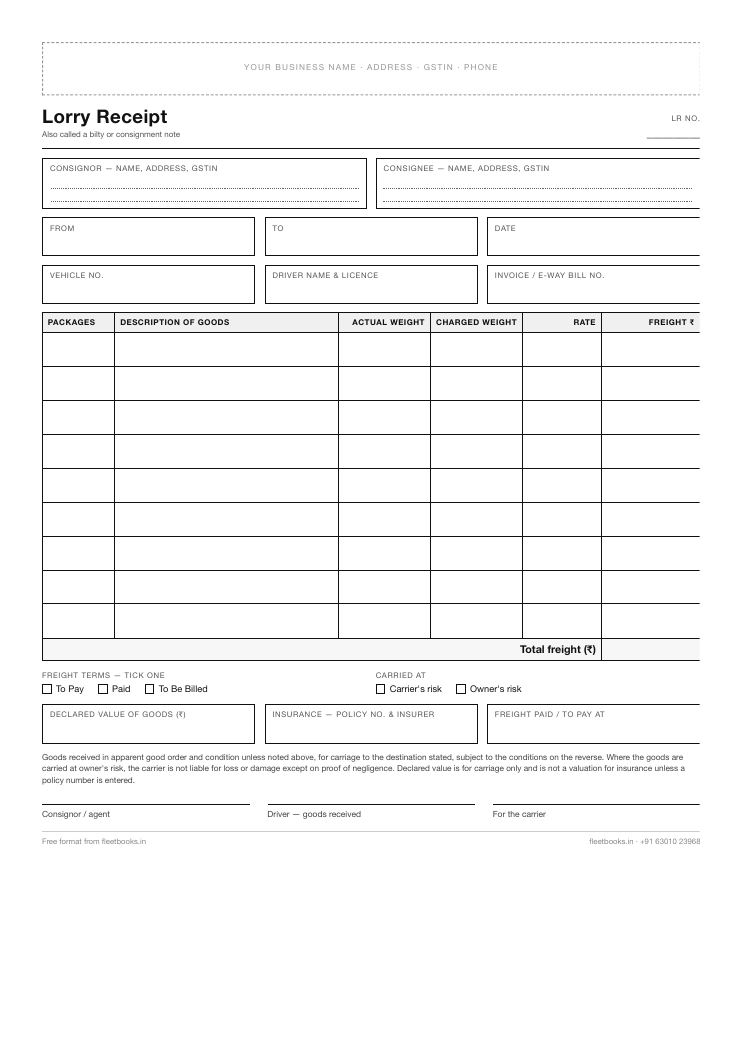
These are the fields on our free LR, in the order they appear on the sheet.
- Take the next LR No. Top right. Take the next number in your series before you fill anything else.
- Fill both parties. “Consignor — name, address, GSTIN” and “Consignee — name, address, GSTIN”.
- Route and date. From, To and Date.
- Vehicle and driver. Vehicle no. and Driver name & licence.
- Invoice / e-way bill no. Enter it if the consignment has one.
- Fill the goods table. Packages, Description of goods, Actual weight, Charged weight, Rate and Freight ₹, then Total freight (₹).
- Tick the freight term and risk. Freight terms — tick one: To Pay, Paid or To Be Billed. Carried at: Carrier’s risk or Owner’s risk.
- Add value and insurance. Declared value of goods (₹), Insurance — policy no. & insurer, and Freight paid / to pay at.
- Sign. Consignor / agent, Driver — goods received, and For the carrier.
- Print one sheet per copy. The A4 sheet has one fixed copy stamp, so print it once for each copy you need and write the copy name (consignor, consignee, driver) on each. For separate consignor, consignee and driver copies already laid out, use the triplicate LR book.
The LR copy format page has this sheet blank. You type straight on it and download PDF, Word or Excel, with no sign-up. If you want the freight worked out from charged weight × rate, use the LR copy in Excel. The same sheet is on the bilty format page for anyone who looks for it under that name.
09 · FAQ
Frequently asked questions.
- What is the LR copy?
- An LR copy is a copy of the lorry receipt (LR), the document a transporter issues when it takes goods from a consignor. It records what was handed over, in what condition, to which vehicle and driver, and where the goods are going. It is also called a bilty or a consignment note.
- What is the LR full form?
- LR stands for lorry receipt. When someone asks you for the LR, the LR copy, the bilty or the consignment note, they want this document.
- How do I generate an LR copy?
- Open the free LR copy format on fleetbooks.in, type on the blank A4 sheet and download it as PDF, Word or Excel. No sign-up is needed. Take the next number in your LR series before you fill anything else. If you issue many, the triplicate LR book gives pre-numbered sheets with a copy label on each.
- Are the LR copy and the e-way bill the same?
- No, and one does not replace the other. The LR is the transporter’s own document acknowledging the goods. The e-way bill is generated on the GST e-way bill portal under Rule 138 of the CGST Rules, by the consignor, the consignee or the transporter. The LR number goes into Part B of the e-way bill as the transport document number.
- What is a bilty in logistics?
- A bilty is the same document as a lorry receipt. The word is common in the North and West of India, while lorry receipt and LR are the usual words in South India. A bilty carries the same fields, including the freight term: To Pay, Paid or To Be Billed.
- How do I make a transport bilty?
- Take the next bilty (LR) number, fill the consignor and consignee, route and date, vehicle and driver, the goods table with weight, rate and freight, tick one freight term and the risk basis, then sign. The free bilty format has all of these fields on one A4 sheet.
- How many copies of an LR are there?
- For a common carrier, the Carriage by Road Act, 2007 requires the goods receipt to be issued in triplicate, with the original given to the consignor. The Act does not say who gets the other two copies. Practice varies, and some LR books are printed with four copies.
Free, no sign-up
Fill the LR copy, download it, print the copies you need.
The blank A4 lorry receipt downloads as PDF, Word or Excel. Need pre-numbered sheets for every load? The triplicate LR book has them.
Also: bilty format · LR copy in Excel · triplicate LR book