
GST guide
GST on Transport Bills: Who Pays, 5% or 18%, and Annexure V
Unless a goods transport agency has opted to pay GST itself, a GST-registered customer pays the tax on the freight under reverse charge. How the 5% and 18% options work since 22 September 2025, how to opt in, and what the bill must say.
Published • 11 min read • GST · Transport bills
What is the GST rate for a transport bill?
5%, or 18% if the goods transport agency (GTA) has opted to charge GST itself with full input tax credit. If the GTA has not opted, a GST-registered customer pays the 5% itself under reverse charge, and the bill charges no tax. A GTA that has opted for forward charge charges either 5% with no input tax credit or 18% with full input tax credit. The 18% rate applies from 22 September 2025, up from 12%.
- Reverse charge, customer pays
- 5%
- Forward, no input credit
- 5%
- Forward, full input credit
- 18%
- With credit, before 22 Sep 2025
- 12%
When a goods transport agency bills a GST-registered customer for taxable freight, the tax works in one of three ways: reverse charge, forward charge at 5%, or forward charge at 18%. Which one applies decides who pays the tax, whether the bill shows any, and what it has to say. Some transport of goods is exempt from GST; this guide does not cover the exemptions.
Need the bill itself?
Our free transport bill puts the GST position on the face of the bill as a tick-box: reverse charge, forward at 18% or forward at 5%. Type on it and download PDF, Word or Excel. No sign-up.
01 · Reverse charge
Who pays GST on a transport bill?
By default, the customer, under the reverse charge mechanism (RCM). Transport of goods by a goods transport agency (GTA) is on the reverse-charge list in Notification 13/2017-Central Tax (Rate). When the GTA has not opted to pay the tax itself, the recipient pays the GST at 5% (2.5% CGST and 2.5% SGST), and the GTA charges none.
The reverse-charge entry covers these recipients:
- a factory
- a society
- a co-operative society
- a person registered under the CGST, IGST, SGST or UTGST Act
- a body corporate
- a partnership firm, registered or not
- a casual taxable person
A customer outside that list, such as an individual who is not registered, is not covered by this entry. Check how that bill is treated with your tax adviser.
Under reverse charge the GTA does not take input tax credit on the goods and services it uses to supply the transport. The bill charges no tax. Rule 46 of the CGST Rules requires an invoice to say whether the tax is payable on reverse charge, so say so on the bill.
Who counts as a GTA. GST defines a goods transport agency as a person who provides service in relation to transport of goods by road and “issues a consignment note by whatever name called”. The lorry receipt or bilty is that consignment note.
02 · Forward charge
Is GST on a transport bill 5% or 18%?
5% under reverse charge. A GTA that opts out of reverse charge pays the GST itself, which is called forward charge, and charges the tax on its bill at one of two rates: 5% or 18%.
5%
Reverse charge
Paid by the customer. The GTA charges no tax and takes no input tax credit.
5%
Forward charge
Charged on the bill and paid by the GTA. No input tax credit.
18%
Forward charge
Charged on the bill and paid by the GTA, with full input tax credit. From 22 September 2025.
The 18% rate is new. Notification 15/2025-Central Tax (Rate), dated 17 September 2025, raised the central tax for a GTA that has opted to pay the tax itself from 6% to 9%, with effect from 22 September 2025. With the matching state tax, the with-credit rate went from 12% to 18%. The same entry still offers 2.5% central tax, so the 5% option did not change.
The PIB FAQ on the 56th GST Council’s decisions, published on 3 September 2025, puts it this way: “The transportation of goods by GTA will continue to be taxed at the merit rate of 5% with no ITC. However, the GTA will have the option of charging GST at the standard rate of 18% with full ITC.”
So the difference between the two forward-charge rates is input tax credit. At 5% the GTA cannot take credit for the GST on its own inputs; at 18% it can take full credit. A bill template that still prints 12% for the with-credit option is out of date. The tick-box on our free transport bill format reads 18%.
03 · Annexure V, VI, III
How does a GTA opt for forward charge?
With a form filed before the financial year starts, and a declaration on every bill after that. The timing is set by Notification 06/2023-Central Tax (Rate).
- File Annexure V before the year. The window is 1 January to 31 March of the financial year before the one you want forward charge for. For the year starting 1 April 2027, that is 1 January to 31 March 2027.
- It carries forward. Since 27 July 2023 the option stays in force for later years without filing again. Before that, it lapsed every year and the deadline was 15 March.
- File Annexure VI to go back. To return to reverse charge, the GTA files Annexure VI, in the same 1 January to 31 March window.
- It holds for at least a year. Annexure V says the option cannot be changed within one year from the date it is exercised.
- Put Annexure III on every forward-charge bill. Each tax invoice issued under forward charge carries this declaration, with the financial year filled in:
Annexure III declaration
“I/we have taken registration under the CGST Act, 2017 and have exercised the option to pay tax on services of GTA in relation to transport of goods supplied by us from the Financial Year ____ under forward charge and have not reverted to reverse charge mechanism.”
Leave it off and the bill does not meet the conditions for leaving reverse charge. The reverse-charge entry stops applying only where the GTA has registered under GST, opted for forward charge, and issued a tax invoice charging the tax with the Annexure III declaration on it.
04 · On the bill
What must a transport bill state?
Two rules in the CGST Rules decide it. Rule 46 sets what every tax invoice must contain, including whether the tax is payable on reverse charge. Rule 54(3) adds what a GTA’s tax invoice, or the document it issues in its place, must carry:
- the gross weight of the consignment
- the names of the consignor and the consignee
- the registration number of the goods carriage
- details of the goods transported
- the place of origin and the destination
- the GSTIN of the person liable to pay the tax, whether that is the consignor, the consignee or the GTA
- the other details Rule 46 requires
On top of that, the GST position decides two lines:
Reverse charge
No tax on the bill, and a line saying the tax is payable by the recipient on reverse charge.
Forward charge, 5% or 18%
The tax charged at the rate the GTA opted for, and the Annexure III declaration.
What our free bill already has
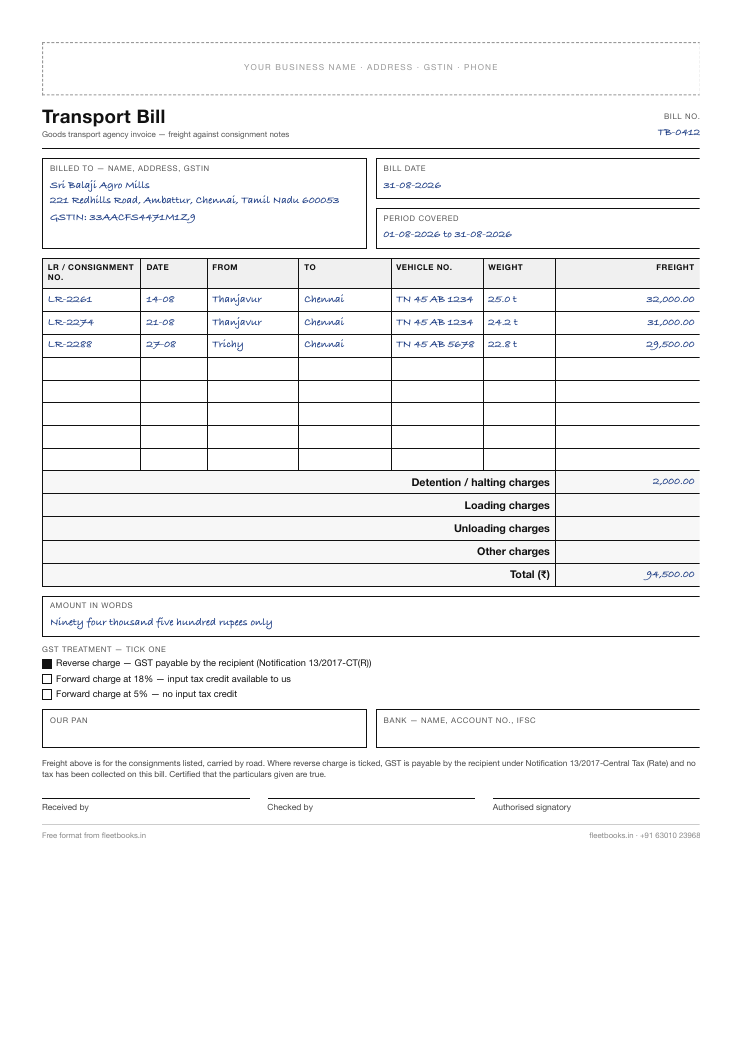
Our transport bill format has a line per LR with the LR number, date, from, to, vehicle number, weight and freight; the customer’s name, address and GSTIN under Billed to; your GSTIN in the letterhead; and a GST tick-box with three choices: reverse charge, forward charge at 18%, or forward charge at 5%. Its printed declaration says that where reverse charge is ticked, GST is payable by the recipient and no tax has been collected on the bill.
What it does not have: columns for the consignor and consignee names and for a description of the goods, which are fields on our lorry receipt; a tax line; and the Annexure III declaration. If you charge forward, or want those details on the bill itself, add them in the Word version, which is an editable copy. The rule asks for the gross weight, so if you bill on a different charged weight, show both.
05 · Example
Worked example: ₹1,00,000 of freight.
Illustrative figures, not a real bill. A GTA bills a GST-registered customer in the same state ₹1,00,000 of freight for one month, so the tax splits equally into CGST and SGST.
| Reverse charge | Forward at 5% | Forward at 18% | |
|---|---|---|---|
| Freight | ₹1,00,000 | ₹1,00,000 | ₹1,00,000 |
| CGST on the bill | — | ₹2,500 | ₹9,000 |
| SGST on the bill | — | ₹2,500 | ₹9,000 |
| Bill total | ₹1,00,000 | ₹1,05,000 | ₹1,18,000 |
| Who pays the GST | Customer, ₹5,000 | GTA, ₹5,000 | GTA, ₹18,000 |
| GTA’s input credit | None | None | Full |
In the first two columns the tax is the same ₹5,000. What changes is who pays it to the government and what the bill shows. At 18% the tax is ₹18,000 and the GTA can take full input tax credit on its own inputs; whether that leaves it better off depends on the GST it pays on those inputs, which this example does not model.
06 · The document
What is a transportation bill?
A transport bill, also called a freight bill, is the invoice a transporter raises for freight it has already carried. It lists the consignments it covers, usually one line per lorry receipt (LR) with the trip and the freight for each, and it is usually raised for a period such as a month.
It is not the lorry receipt. The LR travels with one consignment and records the goods handed over for carriage. The bill comes afterwards and asks for payment, and the LR numbers on it are the link between the two.
For the LR itself, our guide explains what an LR copy is, who keeps which copy and how it differs from an e-way bill.
07 · Free format
How to make a bill for transport.
The quickest route is a ready format with the GST position already printed on it.
- Open the format. Go to the transport bill format and pick how you prepare the bill: blank A4, filled sample, Excel, Word, or the duplicate bill book.
- Fill the header. Your business name, address and GSTIN; the customer’s name, address and GSTIN under Billed to; the bill number, the bill date and the period covered.
- One line per LR. LR number, date, from, to, vehicle number, weight and freight.
- Extras on their own lines. Detention or halting, loading, unloading and other charges, then the total and the amount in words.
- Tick the GST position. Reverse charge, forward at 18% or forward at 5%. If you charge forward, add the tax and the Annexure III declaration.
- PAN, bank, signature. Add your PAN and bank details, sign, and download PDF, Word or Excel. No sign-up.
If you bill from a spreadsheet, the transport bill in Excel adds up the freight lines first and then the extra charges, and the GST position is a dropdown.
Free transport bill
Put the GST position on the face of the bill.
Blank A4, a filled sample, Excel, Word or a duplicate bill book. The A4 bill has the reverse-charge and forward-charge tick-box printed on it. Type on it, download, print. Free, no sign-up.
Billing from a spreadsheet? Use the transport bill in Excel.